Bob Dylan songs have a habit of sneaking up on me. I can listen to a song for years and think of it as just another song on an album, and then, without warning, that very same song will suddenly come into bloom before my eyes. For this reason, I’m always cautious about dismissing anything Bob Dylan does, as there’s a good chance that I'll come to love it eventually if I don’t get it right away.
The latest song to reveal itself in this manner has been ‘What Good Am I?’, from 1989’s Oh Mercy. Until recently, this song had always passed me by, perhaps due to it being placed immediately after the twin peaks of ‘Man in the Long Black Coat’ and ‘Most of the Time’. It wasn’t the studio version that turned me onto ‘What Good Am I?’, however: it was a live performance from 23rd April 2014 in Osaka, Japan.
Usually, Dylan songs go through various permutations as they are performed over the years. Nothing is sacred, with lyrics, melody and arrangement often torn apart and reassembled like one of Dylan’s scrap-metal sculptures. Curiously, despite being performed more than 200 times over a 25-year period (1989-2014), ‘What Good Am I?’ remained strangely immune to this practice. Not only did the arrangement change very little over that time, but the song also seems to have been played in the same key (E) for this entire period. This is extremely unusual, but it also raises the question of why this song remained relatively untouched by Dylan’s famous tendency towards reinvention.
Dylan’s comments on the song in his autobiography Chronicles offer some potential answers:
“When we began working on “What Good Am I?” I had to hunt for a melody and after working on it for a suitable amount of time Danny [Lanois, producer] thought he heard something. I thought that I was onto something but hadn’t quite found it yet. I was looking too hard. When it’s right, you don’t have to look for it. Maybe it was only a foot and a half away, I didn’t know. But I had exhausted my energy and thought I might as well just go with what Lanois liked, although it was too slow for my taste. Danny used layered rhythms to create a mood for this song. I liked the words, but the melody wasn’t quite special enough – didn't have any emotional impact. Setting aside our personal differences, we worked on this song for a while and completed it.”
It sounds like Dylan felt that he had allowed the song to slip through his fingers in the recording studio. “I thought that I was onto something but hadn’t quite found it yet”. “Maybe it was only a foot and a half away”. This is probably a common occurrence for Dylan, but the fact that he altered the song so little over years of live performance suggest to me that, in the case of ‘What Good Am I?’, the studio version was just a hair’s breadth away from what he was hoping to achieve. If his vision couldn't be realised in the studio, perhaps it could be onstage.
There are many other wonderful live versions of this song (Nagoya 1994 is a particular favourite), but – for now at least – the Osaka 2014 is the one for me. Where the narrator on the studio version found himself facing a sudden, terrible epiphany of self-doubt, the atmosphere in the Osaka performance is very different. The song has now taken on the feel of a Shakespearean soliloquy, with the narrator, now much older, staring into his own soul, or perhaps up towards the sky, and asking “Am I a good person? And if not, can I be redeemed?”. These are the same questions Michael Corleone was seeking to answer in The Godfather Part III, and that Frank Sheeran faced at the end of The Irishman. In both of their cases the answer was a devastating “no”, but the fate of our narrator is left much more ambiguous.
The song ends with a beautiful pedal steel/electric guitar flourish. It’s one of those rare performances where, although the band is playing during the whole song, it feels as though Bob is onstage entirely alone, as was the case with ‘Song to Woody’ in 1999/2000 and ‘Don’t Think Twice’ in 2018/19. Even the audience recedes far into the distance. All that remains is one man, alone with his thoughts.
*
The Osaka 2014 performance is not on YouTube, unfortunately, but I did find an performance from five days earlier in Nagoya that's almost as good:
"My Captain's decorated, he's well schooled and he's skilled"
- Bob Dylan, 'Lonesome Day Blues'
In the ‘Caribbean Wind’ entry of his excellent ‘100 Favourite Bob Dylan Songs’ series (which, by the way, is now available in glorious pdf format), Sigismund Sludig raised an interesting question that I’ve been thinking about ever since: who was/is Bob Dylan’s Ben Keith? Ben Keith, of course, was the masterful pedal steel player/multi-instrumentalist who accompanied Neil Young between 1972 and Keith’s death in 2010. Neil has had many long-term collaborators over the years – Nils Lofgren, Nicolette Larson, even entire bands like Crazy Horse and Promise of the Real – but Ben Keith was clearly his guy. As he said in a 2011 interview:
“This guy is one of the great steel players of all time. Other steel players always refer to him; producers say “Can you play kind of like Ben Keith?”, and nobody can play like Ben Keith. So, I’m not gonna be doing any more of the songs that I’ve cut with Ben Keith …. not with anybody else. I’ll do them by myself, so that I can hear Ben in my head, but I won’t play them with anybody else. There won’t be anybody trying to play what he played.”
Has Bob Dylan ever had this kind of relationship with another musician? I would say that there are many who could have filled this role, and perhaps did for a time: Michael Bloomfield, Al Kooper, Robbie Robertson, Jim Keltner, Rob Stoner, Scarlet Rivera, Tim Drummond, Willie Smith, Benmont Tench, Mike Campbell, G.E. Smith, Bucky Baxter, Winston Watson, Larry Campbell, Charlie Sexton, Freddy Koella, Elana Fremerman. All of these musicians (and doubtless others I'm forgetting) were able to connect to Dylan on a level bordering on the telepathic, with Dylan channelling their energy into his performance. However, I would also argue that Dylan tended to stop short of allowing these players the kind of space and freedom that Neil Young afforded Ben Keith; on the rare occasion that he has, it has tended to be for a relatively short period of time before a) Bob broke up the band and moved onto something else b) the musician left the band, or c) the musician stayed in the band and gradually found him or herself playing an increasingly reduced role.
To my mind, the ultimate sideman is someone who the artist simply cannot do without, whose contribution to the artist's music cannot be replaced or replicated once that person is gone, and whose mere presence onstage or in the studio brings the artist reassurance and confidence. Frank Sinatra had Bill Miller; Chuck Berry had Johnnie Johnson; Ali Farka Toure had Oumar Toure. The leading candidate for this position in Bob Dylan’s music is, as far as I’m concerned, bass player Tony Garnier.
Tony joined Bob’s band in 1989, as a temporary replacement for an ailing Kenny Aaronson, and has stayed ever since. When guitarist G.E. Smith left the group in October 1990, Tony assumed the responsibilities of bandleader/musical director, meeting up with Bob on the day of the show to devise the evening’s setlist, and keeping track of keys, tempos and song endings. When things occasionally veered off course onstage – which was much more common during the ragged early years of the Never Ending Tour – it was Tony’s job to steady the ship. In 2010, Tony was the only member of Dylan’s band to accompany Bob to the White House to play for President Obama at 'A Celebration of Music from the Civil Rights Movement.'
More important than all of that, however, is the fact that Tony is simply an incredible bass player. Checkout out his swinging, often jazzy work on Time Out of Mind, or his masterful double bass playing all the way through Dylan’s trio of Great American Songbook albums. He never draws attention to himself, but when you zero in on what he’s doing you realise its brilliant, all the time; the perfect foundation on which Dylan is able to build. Tony is the glue that holds it all together.
Whenever I think of what Tony Garnier means to the music of Bob Dylan, I am always reminded of an incident that occurred in Vienna in April 2019. Bob, losing his temper with a member of the audience who insisted on taking photographs despite a strict ‘no photos’ policy, stepped up to the microphone to admonish the offender. Having done so, he stepped backwards and tripped over one of the wedge monitors. Whose arms did he stumble safely into? You guessed it: Tony Garnier. A terrifying moment, but you'd be hard-pressed to find a better visual metaphor for the Never Ending Tour than Bob stumbling and steadying himself on Tony Garnier. Later that year, Dylan would take to introducing his bass player as having "been with me longer than I've been with myself."
As Andrew Muir, one of my favourite Dylan writers, said of Garnier in a 2013 interview, “there should be statues erected in honour of Tony”.
“That’s what it is. It’s work. All artistic endeavour requires effort. It requires work. More than anything else – more than inspiration, more than influence, even more than aesthetic. For me, it just requires showing up and doing it. Talk to any painter, any photographer, any sculptor, any musician, any poet, any writer – it’s showing up! If you gotta do the thing, then you gotta do the thing. That’s really what it’s all about.
- Pixies frontman Black Francis, 2019 Guitar.com interview
In November 2016, less than a month before his death, Leonard Cohen held a press conference to celebrate the release of his new album You Want It Darker. When asked about how he had continued to produce high quality material over such a long period of time, Leonard had this to say:
“I think that any songwriter, and I think that Bob Dylan knows this more than all of us … you don’t write the songs anyhow. If you’re lucky, you can keep the vehicle healthy and responsive over the years; if you’re lucky, your own intentions have very little to do with this. You can keep the body as receptive and well-oiled as possible, but whether you’re actually going to be able to go for the long haul is really not your own choice.”
Few people know of the songwriter’s struggle as well as Cohen, who was known to labour over songs for many years before deeming them ready for the world. It’s interesting, though, that he goes out of his way to mention Dylan, who has previously spoken of his own difficulties in keeping his creative engine, as Leonard calls it, “receptive and well oiled”. The topic came up during Dylan’s 2004 interview with the late Ed Bradley on 60 Minutes:
Bradley: Do you ever look at music that you’ve written, and look back at it and say ‘whoa, that surprised me’?
Dylan: I used to. I don’t do that anymore. I don’t know how I got to write those songs.
Bradley: What do you mean you don’t know how?
Dylan: Well, those early songs were almost like magically written. [quotes the first verse of ‘It’s Alright Ma (I’m Only Bleeding)’] Well, try to sit down and write something like that. There’s a magic to that, and it’s not Siegfried & Roy type of magic. It’s a different kind of a penetrating magic, and I did it at one time.
Bradley: You don’t think you can do it today?
Dylan: [shakes head]
Bradley: Does that disappoint you?
Dylan: Well, you can’t do something forever, and I did it once. I can do other things now, but I can’t do that.
It’svery common for an artist’s creative process to change over time; Cohen, for example, often worked with collaborators like Sharon Robinson and Patrick Leonard to set his lyrics to music in later years. Bob Dylan’s solution to his changing relationship with his muse was somewhat different: as he entered the 21st Century, Dylan began constructing songs from a variety of existing sources, using old songs from the ‘30s, ‘40s and ‘50s as the basis for his arrangements, and applying a variant of the ‘cut-up technique’ for his lyrics, often using phrases from existing texts. While there has always been a ‘borrowing’ element to Dylan’s work, this was something different.
Dylan has been aware of the cut-up technique since at least 1965. Incredibly, Don’t Look Back director D.A. Pennebaker actually captured footage of him explaining the concept at length that very year, and revealing that an attempt to use it for one of his songs “didn’t work out”. Bob used a variation of the method to edit his films Eat The Document and Renaldo and Clara, and appears to have tried out the technique again for his 1985 album Empire Burlesque, which featured a surprising number of lines from Humphrey Bogart films. However, he seems to have only truly committed himself to the practice in the 1990s, as director Larry Charles discovered when he entered talks with Bob to create a slapstick comedy TV series with Dylan in the lead role (which later evolved into the 2003 film Masked & Anonymous). As Charles recalled in an interview on Pete Holmes’ You Made It Weird podcast in 2014:
“He brings out this very ornate beautiful box, like a sorcerer would, and he opens the box and dumps all these pieces of scrap paper on the table … Every piece of paper was hotel stationary, little scraps from, like, Norway and Belgium and Brazil, and each little piece of paper had a line. Some kind of little line, or a name, scribbled - “Uncle Sweetheart” - or a weird poetic line, or an idea… I realised: that’s how he writes songs. He takes these scraps and puts them together, and makes this poetry out of that.
This technique was in evidence when Dylan came to record Time Out of Mind in 1997. Thanks to the release in 2008 of The Bootleg Series Volume 8: Tell Tale Signs, which contains numerous Time Out of Mind outtakes and alternate takes, we can see how various lines and phrases migrated from one song to another. For example:
* The outtake ‘Marchin’ to the City’ - which the liner notes tell us gradually evolved into ‘’Til I Fell in Love with You’ - contains the lines “Looking for nothing in anyone’s eyes” and “Go over to London/Maybe gay Paree/Follow the river/You get to the sea”, both of which ended up in ‘Not Dark Yet’ in a slightly reworked form.
* The early version of ‘Can’t Wait’ features the phrase “Think you’ve lost it all, there’s always more to lose”, which found its way into ‘Tryin’ to Get to Heaven’ as “When you think that you’ve lost everything/You find out you can always lose a little more”. As is noted in the liner notes, the song also contains the lines “My back is to the sun because the light is too intense/I can see what everybody in the world is up against” which became the opening lines of ‘Sugar Baby’ on “Love & Theft”.
* A large portion of the lyrics from the outtake ‘Dreamin’ of You’ were included in ‘Standing in the Doorway’, although one line (“Feel further away than I ever did before”) turns up slightly rephrased in ‘Highlands’.
* The research of Scott Warmuth has also revealed that a number of phrases on the album are derived from the work of Henry Rollins.
Why did Dylan adopt this method? The most likely answer is, as Leonard Cohen said, that “you don’t write the songs anyhow”. Creativity is often hard work, a grind, and genuine inspiration is too rare to be relied upon. In a 1978 interview with Matt Damsker, Dylan had spoken of learning to do “consciously what I used to do unconsciously” in his songwriting, and the creative process he leaned into in the 21st Century could be seen as an extension of that mindset.
The same creative process would be used on Dylan's next album, 2006’s Modern Times (and also in his autobiography, Chronicles - but that really deserves an article of its own). Lyrical sources on the album included Ovid and Civil War-era poet Henry Timrod, while arrangements and/or melodies were drawn from the likes of Muddy Waters, Bing Crosby, and Memphis Minnie and Kansas Joe McCoy. Dylan changed tack for the following album, 2009's Together Through Life, co-writing the lyrics with the Grateful Dead’s Robert Hunter, but the album still included some borrowed arrangements, one of which – the arrangement of Muddy Waters’ ‘I Just Want to Make Love to You’, which was used for ‘My Wife’s Home Town’ - was acknowledged in the album credits. Tempest (2012) featured arrangements and melodies derived from a range of artists including Bobby Fuller Four, The Greenbriar Boys, and The Carter Family, while several phrases in ‘Scarlet Town’ have been found to originate from the work of 19th Century poet John Greenleaf Whittier.
*
One of the most interesting aspects of the 60 Minutes interview is Dylan’s visible disappointment about how his relationship with his creativity has changed since the 1960s. It’s rare for him to touch on the subject publicly; while Bob has been quizzed about his borrowing of lyrical material, he has never (as far as I can tell) been asked about his reasons for doing so. On the other hand, perhaps the best place to look for the answer to that question is within the songs themselves.
‘Ain’t Talkin’’, the final song on Modern Times, is a song I have always found rather elusive; until recently, it never quite grabbed me in the same way that many Bob Dylan album closers have. However, a close examination reveals that there’s a lot going on in the lyrics, many of which seem to relate to the narrator’s loss of his former powers. Take the seventh verse, for example:
Well, it's bright in the heavens and the wheels are flyin'
Fame and honor never seem to fade
The fire gone out but the light is never dyin'
Who says I can't get heavenly aid?
The narrator seems to be saying that although his powers have diminished, no one has noticed, and, through the grace of God, he still enjoys the same “fame and honor” that he did in his earlier years. It’s certainly true that Dylan had enjoyed commercial and critical acclaim from Time Out of Mind onwards, with most reviewers and the public either unaware or unconcerned with the second-hand nature of some of the material.
Other phrases jump out: lines like “My eyes are filled with tears, my lips are dry”, “my mule is sick, my horse is blind” and “They will tear your mind away from contemplation” hint at writer’s block, while “Carryin’ a dead man’s shield” and “There’s no one here, the gardener is gone” almost sound like an admission of imposter syndrome. And then there’s the song’s eerie refrain: “Ain’t talkin’, just walking”. Maybe that’s what Bob felt he was doing at this point in time, traversing the globe on his Never Ending Tour but unable to connect with his muse in the way he once had. It’s a desperately sad song, but the closing major chord, which ends the minor-key song on an unexpectedly upbeat note, perhaps offered a sign that all was not lost.
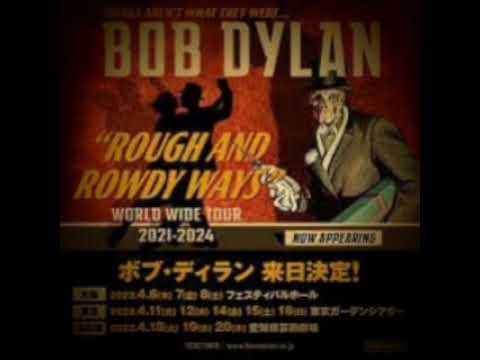
Indeed, I’m relieved to report that this story has a happy ending. Beginning in 2014, Bob Dylan immersed himself in recording and performing material from the Great American Songbook, and when he spoke about these songs at length (to Robert Love in 2015 and Bill Flanagan in 2017) it was clear that his passion for the songwriting craft remained undimmed. Re-familiarising himself writers like George Gershwin, Gus Khan and Hoagy Carmichael paved the way for Dylan’s own return to songwriting after an eight-year hiatus, and his new album Rough & Rowdy Ways was released in June 2020.
Although there’s still some borrowing on Rough and Rowdy Ways, no one has (so far, at least) unearthed appropriation on the scale of Dylan’s previous 21st Century albums. For his part, Dylan’s comments about the writing of his new songs are the polar opposite of his despondent remarks to Ed Bradley in 2004. As he happily reported to Douglas Brinkley in a New York Times interview (in reference to the song ‘I Contain Multitudes’):
“I didn’t really have to grapple much. It’s the kind of thing where you pile up stream-of-consciousness verses and then leave it alone and come pull things out. In that particular song, the last few verses came first. So that’s where the song was going all along. Obviously, the catalyst for the song is the title line. It’s one of those where you write it on instinct. Kind of in a trance state. Most of my recent songs are like that. The lyrics are the real thing, tangible, they’re not metaphors. The songs seem to know themselves and they know that I can sing them, vocally and rhythmically. They kind of write themselves and count on me to sing them.”
It’s always worth taking what Dylan says with at least a grain of salt, but I believe him – he sounds excited, almost giddy, describing the process behind his new material. As Leonard Cohen said, going “for the long haul” takes hard work and perseverance, and is probably a grind a lot of the time. When inspiration pays an unexpected visit, however, it must feel like it's all worthwhile.
I like writing about Bob Dylan a lot, which is why doing this blog is so much fun. Before the next post, I thought I would post links to some of the other Dylan-related things I've had the opportunity to write over the last year or so.
At Budokan Before 'At Budokan' for Flagging Down the Double E's: A look the the first show of Bob's 1978 tour of the Far East.
In Defence of Bob Dylan's 'Dylan' for Cover Me: I attempt to defend the 1973 album that Columbia put out against Bob's will after he left them for Asylum Records.
Strumming on My Gay Guitar for Flagging Down the Double E's: I use Bob's show at Port Chester in June 2017 as a jumping off point to talk about the strange lead guitar style Dylan adopted in the 1990s.
"There are a lot of places I like, but I like New Orleans better."
- Bob Dylan, Chronicles Volume One
Right now I’m reading a great book by Tom Piazza called Why New Orleans Matters, which was published just two months after Hurricane Katrina in 2005. As well as providing a detailed overview of the city's complex socioeconomics, Piazza tells the story of how he fell in love with New Orleans' culture and its people, and of his personal grief at the devastation caused by Katrina.
One of my favourite passages is Piazza’s description of the New Orleans Jazz & Heritage Festival, which takes place every year at the Fair Grounds Race Course and – despite its name – plays host to a wide variety of musical styles. Here’s a sample of what he has to say:
“New Orleans.... is filled with people who came for Jazz Fest and never left. Or who went home and quit their job and came back. I think Jazz Fest teaches them what to love about the city, and how to love it. It is a kind of distillation of the mythology of the city.
Jazz Fest constantly underlines the relationship between the music of New Orleans (and Louisiana) and the culture as a whole. The food, the parades, the crafts, are all part of a larger fabric, as they are in the city itself. You won’t find posters advertising individual artists’ appearances at the fairgrounds. Music, the logic seems to run, is bigger than any individual’s music. And, furthermore, culture is bigger than music. Jazz Fest brings this notion into focus, gives it life, better than any event I know of.”
Bob Dylan, who has long history with New Orleans dating back to his 1963 song 'New Orleans Rag', has played Jazz Fest three times: in 1993, 2003 and 2006. The 2003 show is my favourite of the three, despite it having been almost completely overshadowed by the non-Jazz Fest concert Dylan played the following day at the nearby Municipal Auditorium, which saw saxophonist Dickie Landry sit in for the entire show. (Incidentally, the Municipal Auditorium was badly damaged by Katrina and remains closed to this day.) While the April 25 show has no special guests to recommend it, it does have Dylan’s then-new guitar player Freddy Koella.
Freddy Koella occupies a curious space in the pantheon of Dylan’s Never Ending Tour musicians. Whilst Dylan always seeks out highly skilled players, they are generally kept on a tight leash; there is never any doubt about who the star of the show is supposed to be. As former band member Larry Campbell put it during an interview in this month’s Dylan Review:
“I knew when I started playing with him the role of the band. Bob Dylan is unique in that Dylan and an acoustic guitar is all you need. He gets everything he is across with that. If you're gonna be a band backing him up, then you need to be as subjective as that acoustic guitar. You can't showboat. It's not a place to draw attention to your skills. It's not your place to detract in any way from the essence of what he's putting out.”
For reasons known only to Dylan himself, Koella was one of the few exceptions to this rule. Perhaps Bob recognised that Koella shared the same all-or-nothing-at-all attitude to his craft, a willingness to venture into uncharted territory despite the risk of total failure. Sometimes it would work, sometimes it wouldn’t, but it was usually interesting either way.
This particular New Orleans performance arrived just two weeks into Koella’s twelve-month stay in Dylan’s band. They hadn’t quite gelled yet as a group, which adds an extra sense of unpredictability, as Koella gradually becomes more and more prominent throughout the show until he and Bob are no longer a star singer and a backing musician, but collaborators, goading each other further into the unknown. The heart of the show is ‘Drifter’s Escape’, where Bob leaves his keyboard and straps on his electric guitar to engage Koella in a bizarre but very exciting guitar duel, which sounds like two Bobs playing at once. Later on, Bob delivers a powerful (and, in hindsight, ominous) ‘A Hard Rain’s A-Gonna Fall’.
This show may not sound like jazz, but that’s exactly what it is: an ensemble of musicians interacting and reacting to each other, creating something unique.
One bittersweet aspect of Why New Orleans Matters is the acknowledgement that, no matter how much New Orleans has rebuilt itself in the years since the hurricane, the scars of Katrina will always remain. This 2003 show is, in some ways, a time capsule of the old New Orleans, something that really hits home when you hear the announcement at the end of the show.
“Ladies and gentlemen Bob Dylan! The great Bob Dylan band! … We are now halfway through the first weekend of Jazz Fest 2003, the 34th Annual New Orleans Jazz & Heritage Festival. What a beautiful, beautiful day. We’d like to thank Mr. Dylan for joining us today, and thank all of you for making this day possible, and this festival possible year after year after year. What a beautiful vibe. I’d like you all to go home safely, and come back tomorrow. One other thing we’d like you to keep in mind this year is that Jazz Fest recycles; what that means is...”
*
There's no footage of Bob Dylan's show at Jazz Fest 2003, but I did stumble across a video of Bob and Freddy repeating their 'Drifter's Escape' guitar duel again nine days later in West Palm Beach:
The last decade has seen a lot of changes to the live Bob Dylan experience. In 2013, having spent most of the preceding 25 years playing setlists that varied considerably from one show to the next, Dylan began playing the same songs each night – a format that fans came to know as ‘The Set’. Over the course of 2014 and 2015, Dylan began including Great American Songbook standards in his show, to the point where through 2016 and 2017 they accounted for a good third of the performance. Recently, I tried to pinpoint what had prompted these changes. Was there a certain point that all of this could be traced back to? The answer: the year 2009...
Before delving into that year, it should be noted that the years 2006-2009 are generally not remembered fondly by fans, for several reasons. One was Dylan's voice, which had deteriorated to an alarming degree that left him with almost no range, combined with a perplexing collection of vocal mannerisms that had emerged over the years and now compounded upon one another to distressing effect. Other issues included Dylan's lack of engagement with the crowd - Bob spent most of the show hunched over a keyboard at the side of the stage, facing away from the audience - and a lack of chemistry between Dylan and his band, who were described in 2007 by Shawn Badgley of The Austin Chronicleas being "so careful not to cross him as to resemble battered children tiptoeing around their napping drunk of a father".
Now, I wasn't there to see any of these shows in person - maybe if I had I might have enjoyed them? - but, based on recordings, Mr Badgley's comments seem unfortunately accurate. There must have been a point where Dylan decided that things needed to change.
In 2009, several important Bob Dylan-related things happened. In April, Dylan released an album, Together Through Life, which he had recorded the previous December whilst working on the soundtrack for the film My Own Love Song. At the centre of the record was the track ‘Forgetful Heart’, a song that only fully revealed itself once it was dramatically reworked on stage that summer. Where Dylan’s live shows at this point had gained a reputation for being overly loud and blues-based, the live version of ‘Forgetful Heart’ was the exact opposite: a quiet, vaguely menacing torch song that was usually met with an awed hush from the crowd. In hindsight, this version of the song, which was performed by Bob from centre stage on harmonica only, could be seen as a precursor to the much quieter, less rock orientated presentation that Dylan would favour from 2013 onwards.
Another significant development occurred in October, with the return to Dylan’s band, after seven years away, of guitarist Charlie Sexton. In his previous stint in the band between 1999 and 2002, Charlie had emerged as one of a small group of musicians who have been able to read Dylan on an almost telepathic level. I’ve often suspected that Dylan needs someone to compete with onstage – someone with enough stage presence that Dylan is forced to up his game in order to keep the audience’s attention focused on himself. This role having been vacant for some time, the return of Charlie appeared to have an immediate revitalising effect on Dylan.
The third very important event of 2009 arrived at the very end of the year in the form of Christmas in the Heart, Bob Dylan’s first ever Christmas album. Far from being some kind of elaborate practical joke, the album turned out to be a sincere collection of holiday-themed pop standards, carols and hymns. While his voice was still extremely weathered, Dylan was clearly giving it everything he had, sticking faithfully to the melodies and belting out the lyrics with real feeling – a sharp contrast to his live performances from earlier in the year. Not only did this album serve as a sharp reminder of Dylan’s interpretive skill, but also his deep love of the music of the ‘30s, ‘40’s and ‘50s: many of these tracks had been recorded by the likes of Bing Crosby, Frank Sinatra and Dean Martin.
What do you get when you combine Bob Dylan, old standards, Charlie Sexton, and a quieter performance style that allows Bob to reclaim the full expressiveness of his voice? You get Dylan’s live performances from 2013 to 2019, which I suspect will come to be regarded as a remarkable late-career purple patch. Hopefully, Bob will soon have the opportunity to continue this run of good form into the 2020s.
Here's the first song Bob played at Charlie Sexton's first show back in the band (a very appropriate choice, in hindsight):
"I've had this strange, eerie feeling that I wasn't all alone, and I'd better know it."
One of the joys of listening to a Bob Dylan record from beginning to end is finding little runs of songs that compliment each other perfectly, like mini-albums within an album. Some of my favourites are 'One More Night' and 'Tell Me That it Isn't True' on Nashville Skyline; 'Ninety Miles an Hour Down a Dead End Street', 'Shenandoah' and 'Rank Strangers to Me' from Down in the Groove; and 'Ring Them Bells', 'Man in the Long Black Coat' and 'Most of the Time' on Oh Mercy. But there's one pair that I think compliment each other better than any of these: 'Is Your Love in Vain?' and 'Senor (Tales of Yankee Power)' from Street-Legal.
Performed 31 times during Dylan's 1978 world tour and then retired forever, 'Is Your Love in Vain?' is not a song that comes up in conversation often. When it does, it's often derided as a sexist rant towards a woman, with the lines "Can you cook and sow, make flowers grow/Do you understand my pain?" coming in for particular criticism. Granted, if you look at the song in those terms, the lyrics don't come off very well. However, that's not how I hear this song: I hear it as being addressed to God.
The official story of Bob Dylan's conversion to Christianity, as related by the man himself during his 1979 performance in San Diego, is that a fan at Dylan's concert in the same venue the previous year - noticing that Dylan appeared unwell - had thrown a small silver cross onto the stage. Dylan picked it up and kept it, and the following evening in Tucson was visited in his hotel room by, as he told Robert Hilburn in November 1980, "a presence in the room that couldn't have been anyone other than Jesus". In May of that year he had described this experience in detail in an interview with Karen Hughes:
"Jesus put his hand on me. It was a physical thing. I felt it. I felt it all over me. I felt my whole body tremble. The glory of the Lord knocked me down and picked me up."
I don't doubt that what Dylan describes is true, but there is evidence to suggest that he was already headed in this direction before these fateful events in San Diego and Tucson. During a December 1977 interview with Jonathan Cott, a short discussion about God and religion yielded this revelation from Dylan:
"You know, I'll tell you: lately I've been catching myself. I've been in some scenes, an I say: "Holy shit! I'm not here alone." I've never had that feeling before the past few months. I've had this strange, eerie feeling that I wasn't all alone, and I'd better know it."
That, to my ears at least, is what 'Is Your Love in Vain?' concerns itself with: feeling an unearthly presence in your life and asking the the questions that might pop into one's mind during such a situation. The narrator makes it clear that he's more than a little sceptical about this new arrival in his life:
Well I've been to the mountain and I've been in the wind
I've been in and out of happiness.
I have dined with kings, I've been offered wings
And I've never been too impressed.
Or, in other, words "I've been around the block a few times and got this far by myself, why should I need your help now?". Why indeed. However, the narrator - like the narrators of the other songs on Street-Legal - comes across as being at the end of his rope and in need of a helping hand. He seems to realise this in the following verse, proclaiming "Alright, I'll take a chance, I will fall in love with you."
The troublesome "Can you cook and sow, make flowers grow" lines, meanwhile, are - as I hear them - a reference to God's ability to create, and also a challenge: show me you are who you say you are. This particular theme continues into the following track, 'Senor (Tales of Yankee Power)'.
Before looking at 'Senor' itself, it's worth talking about the extraordinary manner in which Dylan took to introducing this song during the 1978 World Tour. Initially brief, this introduction gradually grew longer and longer throughout the year until it essentially became a short story, delivered with band playing softly behind him. Here's the version of the tale that Dylan delivered in Charlotte, North Carolina on 10th December 1978:
"I was riding on a train one time from Durango, Mexico to San Diego. I fell asleep on the train and woke up in this town called Monterey. And there was, I guess it was about past midnight. Not too much happening, but just maybe around that time. And a family was getting off the train. An old man was stepping up on the platform to get up on the train. And he came down the aisle and took a seat across the aisle from me. Meantime the train was still in the station. Anyway, I was watching this whole thing through the window which was turned into a long mirror. And finally I felt a strange vibration and I had to turn to look at this man. He wasn't wearing anything but a blanket. So I turned my head to look at him. Both his eyes were on fire, I could easily see that, and there was smoke coming out of his nostrils. I said well this is the man I had to talk to. So I turned back to look out the mirror again. I finally got up the courage to talk to him. And the train started moving an the conversation went something like this."
The general premise of 'Senor' is not far removed from 'Is Your Love in Vain?': both songs relate an encounter with a being of immense power, and express an uncertainty as to whether this being can be trusted. Both songs are almost entirely comprised of questions, with the narrator begging this mysterious presence to provide him with answers. And both songs end with the narrator submitting to this presence. "I just gotta pick myself up of the floor / I'm ready when you are, Senor".
Unlike 'Is Your Love in Vain?', however, there is an awful, creeping feeling that the 'Senor' in question may not be who he says he is. It's almost as if the two songs represent the different possible outcomes of a single choice, which brings to mind a line from a song that Dylan would write a year later: "it may be the devil, or it may be the Lord".
Interestingly, I was unexpectedly reminded of both of these songs while listening to Dylan's new album Rough and Rowdy Ways. Track four is 'I've Made Up My Mind To Give Myself To You', in which the narrator pledges himself to an unnamed companion who has stuck with him through thick and thin; while the following track is 'Black Rider', in which the singer is hounded by the sinister title character, who seems determined to make our hero stray from his path:
Black rider, black rider, all dressed in black
I'm walking away, you try to make me look back
My heart is at rest, I'd like to keep it that way
I don't wanna fight, at least not today
Go home to your wife, stop visiting mine
One of these days, I'll forget to be kind
I can't help but hear these two new songs as sequels to 'Is Your Love in Vain?' and 'Senor (Tales of Yankee Power)', and their placement right beside each other only makes the comparison more irresistible. Where those earlier songs were filled with questions, Dylan - more than four decades later - may have finally provided the answers.